Renting out a room in your own home: rules, lease and tax in 2026
23 September 2026 · 11 min read · Tax
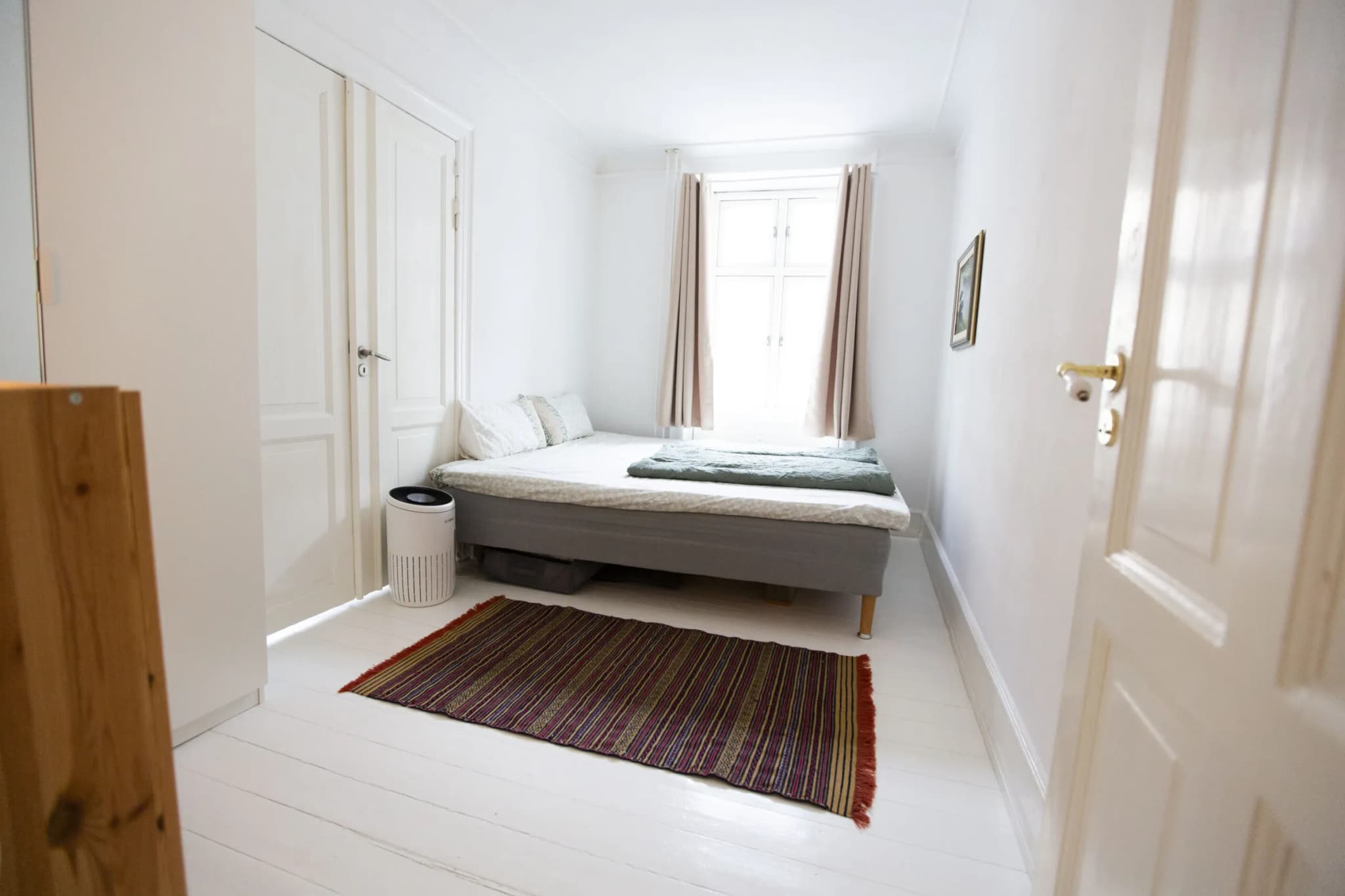
You may rent out a room in the home you live in yourself, whether you own it, have a co-op share or rent it. As an owner you must check the owners’ association’s articles, in a co-op apartment (andelsbolig) the standard articles require the board’s permission, and as a tenant you may sublet up to half of the habitable rooms. If you rent out to the same tenant for at least 4 months, the standard deduction (bundfradrag) in 2026 is 1 1/3% of the property value, at least DKK 24,000, for owners, and 2/3 of the annual rent or housing charge (boligafgift) for tenants and co-op members.
May you rent out a room in your home?
Yes. You can rent out a room in your own home, whether you own it or rent it (Ministry of Social Affairs, in Danish). A room is a tenancy without its own kitchen. If the tenant has their own kitchen, it is an apartment, and other rules apply (City of Copenhagen, in Danish). What else you need to be aware of depends on the type of home.
Owner-occupied home
If you own the home, you typically have the right to rent out a room, but read the owners’ association’s articles, because they can set special requirements, the ministry writes. Under the standard articles for owners’ associations (normalvedtægten, in Danish), the board must be told when the whole apartment is rented out, and the association can, with the support of at least 2/3 of the owners, restrict rentals of less than 31 days (§§ 4 and 30).
Co-op apartment
In a co-op apartment, the association’s articles decide. Under the ministry’s guiding standard articles (in Danish), you may not let anyone outside your household use parts of the home without permission, but the board can allow subletting of individual rooms on conditions it sets itself (§ 11). So apply to the board before the tenant moves in. Read more about renting out a co-op apartment.
Rented home
If you rent your home yourself, you have the right to sublet up to half of the apartment’s habitable rooms (beboelsesrum), and no more people may live in the apartment than there are habitable rooms (section 157 of the Danish Rent Act, lejeloven, in Danish). The sublease must be in writing, and your landlord must have a copy before the sublease starts. You are liable to your landlord for damage the subtenant causes through irresponsible behaviour, and for the house rules being followed (§ 159). The rules apply to private rental homes. Social housing (almene boliger) has its own act (§ 2(3)).
If you do not live in the home yourself and want to rent out the rooms separately, they are known as club rooms (klubværelser). In Copenhagen, renting out an apartment as individual rooms requires the municipality’s consent, and the rent follows the rules for the property’s ordinary apartments (the Housing Conditions Act (lov om boligforhold), § 4(2), in Danish, and the City of Copenhagen).
Which lease should you use for a room?
Use the authorised standard lease, standard form A, 10th edition. It can be used for both apartments and rooms, and in § 1 of the lease you tick that the tenancy is a single room (standard form A, in Danish). The Rent Act requires a pre-printed lease for a single room to be authorised. If you use one that is not, terms that leave the tenant worse off than the law are invalid (§ 14).
If you are a tenant yourself, the sublease must be in writing (§ 157(3)). If you own the home, a written lease is not a requirement, but both you and the tenant can demand one (§ 11(1)), and it makes it easy to prove what you agreed. Get the lease on the page with the free lease agreement, and read how to fill in standard form A10.
You write special terms in § 11 of the lease. For a room in your own home, these could for example be:
- which rooms the tenant may share with you, for example kitchen, bathroom and living room
- whether heating, water and electricity are included in the rent
- house rules for guests, cleaning and quiet
- a notice period longer than 1 month, if you want one
- whether the rent is to be adjusted in line with the net price index
What rent can you charge for a room?
The rent for a room in your own home is set according to the rental value (det lejedes værdi), even in a regulated municipality such as Copenhagen (section 6(3) of the Rent Act, and the City of Copenhagen). That is the rent generally paid for similar rooms in the area, judged by location, size, quality, fittings and state of maintenance (§ 42(2)).
The law does not put an amount on the rent when you make the agreement. But the tenant can ask the Rent Tribunal (huslejenævnet) to reduce it if it significantly exceeds the rental value, and the case must be brought no later than 1 year after the rent first has to be paid (§ 45). If the tribunal reduces the rent, the tenant can claim the overpayment back. If you are unsure about the level, some rent tribunals give a guiding estimate, the Ministry of Social Affairs writes.
For a room, heating can be included in the rent (§ 65(2)). The City of Copenhagen writes that the rent for a room in the landlord’s own home can include all utility costs such as water, heating and electricity, and that separate payment can only be made based on suitable meters, not on estimated use (City of Copenhagen, in Danish). If you want to adjust the rent in line with the net price index, it must be in the lease. Read about rent adjustment.
Deposit and prepaid rent for a room
You can demand a deposit of at most 3 months’ rent (§ 59(1)). You can also demand prepaid rent, but it must not exceed the rent the tenant has to pay from a notice until the tenancy ends, and never more than 3 months’ rent (§ 59(3)). As the notice period for a room in your own home is 1 month, the limit on prepaid rent is low.
If you sublet as a tenant, your tenant can choose to provide a bank guarantee or pay the amount into a separate escrow account instead of a deposit (§ 59(2)). When the sublease ends, you must settle the account and repay any surplus deposit and prepaid rent within 6 weeks, or you can be fined (§ 62(2)). Read more about deposit and prepaid rent.
Notice when you live in the home yourself
If the room is part of the apartment you live in yourself, or of a one- or two-family house you live in yourself, you can give the tenant notice without a special reason (§ 170, no. 1). The notice is 1 month to the first working day of a month that is not the day before a public holiday (§ 175(1)). You can agree a longer notice period, but not a shorter one (§ 181). The tenant can also give 1 month’s notice, unless you have agreed otherwise (the guidance to standard form A).
This freedom has a limit. In a regulated municipality, the Rent Tribunal can overrule a notice if it is linked to an attempt to get an unreasonable rent or unreasonable terms, or if it goes against good letting practice. If the tribunal has reduced the rent, it can decide that the tenant can only be given notice with the tribunal’s approval (§§ 34 and 35).
Put the notice in writing, so you can prove it. When the tenant moves out, the room must be vacated by 12 noon on the moving-out day at the latest, and if you want to claim refurbishment, the claim must as a rule be made no later than 2 weeks after the moving-out day (§ 187).
If you rent out a whole apartment in a house with only two apartments, where you live in the other one yourself, the notice is 1 year, and the notice must be in writing and tell the tenant about the right to object (§ 170, no. 2, § 175(2), and § 176).
Tax on renting out a room in 2026
You only pay tax on the part of the rental income that exceeds your deduction. You can choose between the standard deduction and the accounting-based deduction (regnskabsmæssigt fradrag), and the standard deduction depends on whether you rent out to the same tenant for at least 4 months, and whether you own, rent or have a co-op share (the Danish Tax Agency (Skattestyrelsen), in Danish).
| Your situation | Standard deduction in 2026 |
|---|---|
| You own the home and rent out to the same tenant for 4 months or more | 1 1/3% of the property value, at least DKK 24,000 |
| You rent or have a co-op apartment and rent out to the same tenant for 4 months or more | 2/3 of the annual rent or housing charge |
| Rental of less than 4 months via a platform that reports to the Danish Tax Agency | DKK 35,100. You pay tax on 60% of the rest |
| Rental of less than 4 months without such a platform | DKK 13,800. You pay tax on 60% of the rest |
The property value is the one used for your property value tax (ejendomsværdiskat), and it is on your annual tax statement. The rental income is everything the tenant pays, including for electricity, water, heating and internet. With the standard deduction you cannot deduct other expenses, and as an owner you get no reduction in the property value tax.
An example: You own an apartment with a property value of DKK 3,000,000 and rent out a room all year for DKK 5,000 a month including utilities. The standard deduction is DKK 40,000, so you pay tax on DKK 60,000 minus DKK 40,000, which is DKK 20,000. As an owner, the amount is capital income.
If you rent or have a co-op apartment, the income is capital income for rentals of less than 4 months. From 4 to less than 12 months you choose between capital income and personal income, and for 12 months or more it is personal income.
Instead, you can choose the accounting-based deduction and deduct documented expenses, for example the share of electricity, water and heating that relates to the room. As an owner, you then do not pay property value tax on the rented-out part and can deduct a proportionate share of the land tax (grundskyld), if you rent out at least 10 per cent of the home. If you choose the accounting-based deduction, you cannot later switch to the standard deduction. As a rule there is one standard deduction per home, so if you own the home together, you split it by ownership share. Read more about tax deductions when renting out.
When you would rather rent out the whole home
If you are going away for a while yourself, you can rent out the whole home with a fixed-term lease. Read about renting out temporarily. If you want to rent out the whole home for a longer period without dealing with the tenant yourself, BY Administration handles it with long-term rental: we find and screen the tenant, draw up the lease under the Rent Act and hold move-in and move-out inspections for 8.5% of the monthly rent including VAT. If you rent out the whole home all year, it may be treated as business rental for tax purposes, and then other rules may apply, the Danish Tax Agency writes.
Sources
- The Rent Act (lov om leje, lejeloven), lov nr. 341 of 22 March 2022 as amended (Retsinformation, in Danish)
- The Housing Conditions Act (lov om boligforhold), lov nr. 342 of 22 March 2022 (Retsinformation, in Danish)
- You rent out a room or a home you live in yourself (Danish Tax Agency, in Danish)
- Renting out single rooms (Ministry of Social Affairs, in Danish)
- Renting out rooms (City of Copenhagen, in Danish)
- Rules on the size of the rent (City of Copenhagen, in Danish)
- Standard articles for a private co-op housing association (Ministry of Social Affairs, in Danish)
- Executive Order on standard articles for owners’ associations (Retsinformation, in Danish)
- Standard form A, 10th edition, with guidance (Ministry of Social Affairs and Housing, in Danish)
Frequently asked questions
The key questions, answered briefly.

Have another question?Call +45 50 52 15 37 or book a meeting.
Can you rent out a room in a co-op apartment?
The association’s articles decide. Under the ministry’s guiding standard articles, the board can allow subletting of individual rooms on conditions it sets itself. So apply to the board before the tenant moves in, and use the authorised lease. If you rent out to the same tenant for at least 4 months, the standard deduction is 2/3 of the annual housing charge.
How much can you earn tax-free by renting out a room?
If you rent out to the same tenant for at least 4 months, the standard deduction in 2026 is 1 1/3% of the property value, but at least DKK 24,000, if you own the home, and 2/3 of the annual rent or housing charge if you rent or have a co-op share. Only the income above the deduction is taxed, and payment for electricity, water, heating and internet counts as income.
How much notice is there on a rented room?
If the room is part of the home the landlord lives in, the landlord can give 1 month’s notice to the first working day of a month that is not the day before a public holiday, without a special reason. A shorter notice period cannot be agreed. The tenant can also give 1 month’s notice, unless the parties have agreed otherwise.
Which lease should you use to rent out a room?
Use the authorised standard lease, standard form A, 10th edition, which can be used for both apartments and rooms. The Rent Act requires a pre-printed lease for a single room to be authorised, or terms that leave the tenant worse off than the law are invalid. You write special terms, for example on a shared kitchen, utilities and house rules, in § 11 of the lease.
How big a deposit can you take for a room?
At most 3 months’ rent. You can also demand prepaid rent, but at most equal to the rent the tenant has to pay from a notice until the tenancy ends, and never more than 3 months. As the notice period for a room in your own home is 1 month, the limit is low. If you sublet as a tenant, the tenant can choose a bank guarantee instead of a deposit.
Can you charge extra for electricity, water and heating when renting out a room?
For a room, utilities can be included in the rent. The City of Copenhagen writes that the rent for a room in the landlord’s own home can include water, heating and electricity, and that separate payment can only be made based on suitable meters, not on estimated use. Remember that payment for utilities counts as rental income when you work out the tax.
What rent can you charge for a room?
The rent must not significantly exceed the rental value, meaning the rent generally paid for similar rooms in the area. The law does not set an amount, but the tenant can ask the Rent Tribunal to reduce the rent no later than 1 year after the rent first has to be paid, and claim the overpayment back.
Read next

Airbnb tax in Denmark in 2026: standard deduction, worked example and reporting
23 September 2026
The Social Democrats’ wealth tax proposal: what it means for Danish property owners
29 April 2026