Renting out a furnished apartment in Copenhagen: rent, inventory list and insurance
30 September 2026 · 12 min read · Property management
Contents

Have another question?Call +45 50 52 15 37 or book a meeting.
You can rent out your apartment furnished under the same rules as an unfurnished one. The Rent Act (lejeloven) applies whether the home is let with or without furniture, and you cannot charge a separate payment for the furniture. In Copenhagen, the furnishing is part of the Rent Tribunal’s (huslejenævnet) assessment of the rent in the smaller properties and when you rent out a co-op apartment (andelsbolig), but it does not give a right to a much higher rent. What needs extra care is the inventory list, the move-in report and the insurance.
When does it make sense to rent out furnished?
A furnished apartment makes most sense when the tenant comes to the city without their own household goods, for example an employee on an assignment, an international student or someone between two homes. It can also suit you if you are going away for a while yourself and want to come back to your own things. Then you avoid moving and storing the furniture.
On the other hand, the furniture gets used. The tenant must return the rented property in the same condition as at the handover, apart from wear and tear (§ 187(1) of the Rent Act, in Danish). So a sofa worn by ordinary use is yours to have fixed. Damage the tenant is responsible for, for example from incorrect use or irresponsible behaviour, you can claim. If you have things you do not want to be without or see worn, remove them before you rent out. The information service Forsikringsoplysningen also advises landlords to remove their most valuable things.
On our page with homes to rent, each listing says whether the home is furnished, partly furnished or unfurnished, and home seekers can filter by it. Be just as clear in your own listing about what is included.
Furnished long-term rental or short-term rental?
It is the purpose of the tenancy, not the furniture, that decides which rules apply. The Rent Act does not apply to letting homes for holiday and leisure purposes, apart from § 17 (§ 1(3) of the Rent Act). But according to the explanatory notes to § 1 (in Danish), a normal holiday stay is typically no longer than 6-8 weeks, and short-term letting for work or a posting is covered by the Act. The notes also say directly that the Act applies whether or not the home is let furnished. If you rent out to someone who will work in Copenhagen for three months, it is therefore an ordinary tenancy with the Rent Act’s rules on deposit, notice and fixed terms.
| Topic | Furnished long-term rental | Short-term rental to holiday guests |
|---|---|---|
| Rules | The Rent Act, however long the rental period | The Rent Act does not apply, apart from § 17 |
| Your own permanent home | Can be rented out, for example while you are away. An end date must be justified by your circumstances | At most 70 days per calendar year when all rentals go through intermediaries that report the rental income, otherwise 30 days |
| A home you do not live in yourself | Can be rented out to a tenant who lives there | Requires the municipality’s consent if the home has been used as a permanent residence within the last 5 years |
The limits of 70 and 30 days are set out by the Danish Agency for Planning and Rural Affairs (in Danish), and the consent requirement is in § 7(1) of the Housing Conditions Act (lov om boligforhold), in Danish. If the home is subject to the residence requirement (bopælspligt), it may not be used for occasional residence either, writes the City of Copenhagen (in Danish), and your owners’ or co-op association may have stricter rules on renting out. Read more about the Airbnb rules in Copenhagen and the residence requirement.
What rent may you charge for a furnished apartment?
The furniture does not allow a surcharge on top of the rent. The standard lease says so directly: amounts on top of the rent can only be charged with a basis in law, otherwise they must be included in the rent (standard form A, § 3, in Danish). How much the furniture can count in the rent itself depends on the rules that apply to the home. Copenhagen is a regulated municipality, and here, among other things, the size of the property on 1 January 1995 and whether it was taken into use after 31 December 1991 decide how the rent is set.
| The home | How the rent is set | The furniture |
|---|---|---|
| A property with six or fewer apartments on 1 January 1995, a co-op apartment you rent out, or a rented home you sublet | Compared with similar apartments with cost-based rent (omkostningsbestemt leje). The tribunal can only reduce the rent if it is more than 10 per cent too high | Part of the tribunal’s assessment, but does not give a right to a much higher rent. A separate payment for furniture cannot be agreed |
| A property with seven or more apartments on 1 January 1995 | Cost-based rent based on the property’s expenses (§ 19 of the Rent Act) | No separate payment. The rent follows the rules for cost-based rent |
| A property taken into use after 31 December 1991 | Free rent by agreement (fri leje, § 54). The rent can only be reduced if it is unreasonable | Can be part of the rent you agree |
The City of Copenhagen sets out the rules for properties with six or fewer apartments (in Danish), seven or more (in Danish) and free rent (in Danish). An owner-occupied apartment (ejerlejlighed) follows the rules for the property it was part of on 1 January 1995. If the property was taken into use after 31 December 1991, the rent can be agreed freely, however many apartments it has.
Nor may you make it a condition of the tenancy that the tenant buys your furniture. According to the explanatory notes to § 15 of the Rent Act, it is an illegal key payment (dusør) to make the letting conditional on the tenant buying, for example, fixtures or movable property, even if the price is completely fair. The term is invalid, and the amount must be repaid with interest. That the furniture comes with the tenancy on ordinary terms, on the other hand, is a normal part of a tenancy agreement, the notes say.
Nor can you build the heating into the rent. If you supply heating and hot water to an apartment, the cost cannot be included in the rent but must be charged separately (§ 65(1) of the Rent Act). Other utility costs such as electricity and internet can in some cases be charged on top of the rent if agreed, the municipality writes. If you want an estimate of the rent before you advertise, try the rent calculator, and read about adjustments during the tenancy in the article on rent adjustment.
Inventory list and move-in report
The furniture is yours, and it must be possible to document what came with the home and what condition it was in. The standard lease, standard form A10, has only a short section on fixtures. In § 9 you tick which items belong to you, for example cooker, fridge, dishwasher and washing machine, and there are three lines for other items. For a furnished apartment, that is not enough. Make an inventory list of everything else, both sign it, and give the tenant a copy with the lease. Agreements about the furniture that go beyond the pre-printed text of the lease, for example that it may not be moved out of the apartment, go in § 11.
A good inventory list has:
- Room by room, what is there and how many, for example six dining chairs.
- The condition of the items: new, good or used, and visible marks such as scratches and stains.
- Photos of each item or each wall with furniture, so the photos can be linked to the list.
- Kitchen equipment by number: plates, glasses, cutlery, pots and pans.
- Textiles, if included: duvets, pillows, curtains and rugs.
- Electronics and small appliances with model names, for example TV, router, coffee maker and vacuum cleaner.
- Keys, fobs and codes, and what they are for.
Go through the list at the move-in inspection, and include the furniture in the move-in report. If you rent out more than one residential apartment, you must hold an inspection and make a report, otherwise you generally lose the claim for refurbishment (§ 90 of the Rent Act). If you rent out only one home, the inspection is voluntary, but the report is still your best documentation. Read more about the move-in inspection.
When the tenant moves out, you compare with the list. Your claims for refurbishment must be made no later than 2 weeks after the move-out inspection or, if you have no duty to hold one, 2 weeks after the moving-out day (§ 187(2)). So go through the inventory list at the move-out inspection. The deposit of at most 3 months’ rent is security for the tenant’s obligations on moving out (§ 59(1)). Read about deposit and prepaid rent.
Insurance when the apartment is furnished
Talk to your insurance company before the tenant moves in. According to Forsikringsoplysningen (in Danish), your contents insurance does not cover it if a tenant steals your things or commits vandalism in your home. Things damaged in an accident may be covered if you have extended cover for sudden damage. Ask whether you can extend your insurance as a landlord, and get the answer in writing. If you do not live in the apartment yourself during the tenancy, also ask whether the furniture is covered at the address at all.
If the tenant damages something of yours, the tenant’s liability insurance does not cover it as a rule, because your things are in the tenant’s care during the tenancy, Forsikringsoplysningen writes. Then the tenant pays for damage the tenant is responsible for, and the deposit is your security. Still encourage the tenant to have contents insurance with liability cover, because it can cover damage the tenant causes to others, for example the neighbour below. Read more in the guide to insurance when renting out.
What to include in a furnished apartment
The word furnished does not appear in the Rent Act, so it is your description in the listing and the inventory list that the tenant relies on. Write exactly what is included, and call the home partly furnished if it is only the large pieces. If the tenant should be able to move in with a suitcase, think of:
- Bedroom: bed with mattress, duvet and pillow, space for clothes and curtains that can block out the light.
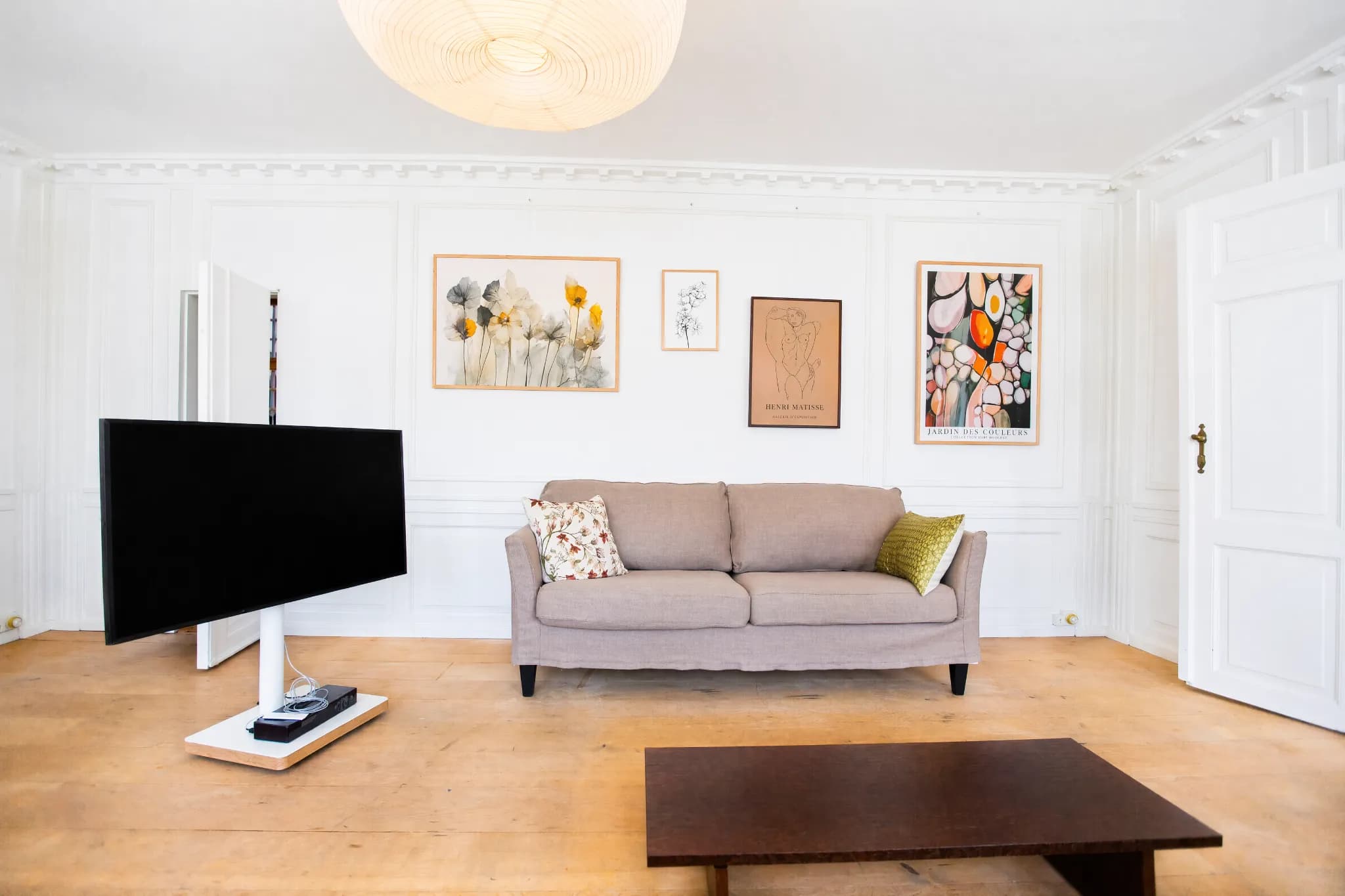
- Living room: sofa, coffee table, lamps and curtains.
- Dining and work space: a table and chairs that can also be used for working.
- Kitchen: crockery, glasses, cutlery, pots, pans, knives, a chopping board, a kettle and a coffee maker.
- White goods: cooker and oven, fridge and ideally a washing machine. These go in § 9 of the lease.
- Cleaning: vacuum cleaner, floor mop and drying rack.
- Internet: agree whether it is included and how it is paid.
Remove personal papers and valuables. If a cupboard or a basement room is to be locked for your own things, write it in § 11 of the lease, so it is clear what the tenant has the right to use. Leave out the manuals for the white goods, and write a short guide to the home, for example about waste, laundry and heating.
Tax when you rent out furnished
If you rent out your own home for part of the year and choose the accounting deduction (regnskabsmæssigt fradrag) instead of the standard deduction (bundfradrag), you can deduct maintenance of and depreciation on furnishings, but not white goods (the Danish Tax Agency, in Danish). With the standard deduction, you cannot deduct expenses, and once you have chosen the accounting deduction, you cannot later switch to the standard deduction. The rental income is everything the tenant pays, including for electricity, water, heating and internet.
If you rent out an owner-occupied home that you do not live in yourself for at least 12 months, it is commercial rental with accounts of income and expenses (the Danish Tax Agency, in Danish). Read more about tax deductions when renting out.
How we can help
If you would rather not do it yourself, BY Administration rents out your apartment, furnished or unfurnished, through our long-term rental service. We advertise the home on our own homes-to-rent page, where the listing shows how it is furnished, screen the tenants, draw up the lease under the Rent Act, collect the deposit and rent and hold move-in and move-out inspections with written and photographic documentation. The price is 8.5% excl. VAT of the monthly rent, and we rent out homes all over Copenhagen and Frederiksberg. See what your home can earn.
The article is based on the Rent Act as it applies in September 2026. It is general information and not legal advice.
Sources
- Act on Rent (lejeloven), Act no. 341 of 22 March 2022 as amended (Retsinformation, in Danish)
- Bill on the Act on Rent (L 47), explanatory notes to §§ 1 and 15 (Retsinformation, in Danish)
- Housing Conditions Act (lov om boligforhold), Act no. 342 of 22 March 2022 as amended (Retsinformation, in Danish)
- Lease for residential use, standard form A, 10th edition, with guide (Ministry of Social Affairs and Housing, in Danish)
- Six or fewer residential apartments in one property (City of Copenhagen, in Danish)
- Seven or more residential apartments (City of Copenhagen, in Danish)
- Apartments with free rent (City of Copenhagen, in Danish)
- Rules on the residence requirement in Copenhagen (City of Copenhagen, in Danish)
- Your own whole permanent home for holiday guests (Danish Agency for Planning and Rural Affairs, in Danish)
- You rent out a room or a home you live in yourself (Danish Tax Agency, in Danish)
- You rent out a home you do not live in yourself (Danish Tax Agency, in Danish)
- Insurance for private rental (Forsikringsoplysningen, in Danish)
Have another question?Call +45 50 52 15 37 or book a meeting.
Frequently asked questions
The key questions, answered briefly.
Have another question?Call +45 50 52 15 37 or book a meeting.
May you charge more rent for a furnished apartment?
Not as a separate amount. Amounts on top of the rent need a basis in law, so payment for the furniture must be part of the rent. In Copenhagen, the furnishing is part of the Rent Tribunal’s assessment in properties with six or fewer apartments on 1 January 1995 and for co-op apartments that are rented out, but it does not give a right to a much higher rent. With free rent, you agree the rent freely.
Does the Rent Act apply when the apartment is furnished?
Yes. According to the explanatory notes to § 1 of the Rent Act, the Act applies whether or not the home is let furnished. It also applies to short tenancies, for example when the tenant will work in the city for a few months. Letting for holiday and leisure purposes, on the other hand, is exempt, and according to the notes a normal holiday stay is typically no longer than 6-8 weeks.
What should an inventory list contain?
Everything included apart from the white goods, which you tick in § 9 of the lease: furniture, lamps, textiles, kitchen equipment and electronics, room by room and by number. Note the condition of the items, and take photos. Both sign the list, and go through it at the move-in inspection and again when the tenant moves out, so you can make any claims within the 2-week deadline.
Can I require the tenant to buy my furniture?
No. According to the explanatory notes to § 15 of the Rent Act, it is an illegal key payment to make the letting conditional on the tenant buying fixtures or movable property, even if the price is fair. The term is invalid, the amount must be repaid with interest, and a breach can be punished with a fine or imprisonment. That the furniture comes with the tenancy on ordinary terms, on the other hand, is fine.
Does my insurance cover my furniture when I rent out?
Not necessarily. Forsikringsoplysningen writes that contents insurance does not cover it if a tenant steals your things or commits vandalism, and that the tenant’s liability insurance as a rule does not cover damage to the landlord’s things during the tenancy. Tell your insurance company that you are renting out furnished, ask whether you can extend the cover, and get the answer in writing.
Can I rent out furnished for only three months?
Yes, but the tenancy follows the Rent Act when the tenant lives there for reasons other than a holiday, for example work. If you want a fixed end date, the fixed term must be justified by your circumstances, for example that you will move back in yourself. According to the explanatory notes to § 173 of the Rent Act, it can be set aside if the reason lies with the tenant, so the tenant’s own schedule is not enough.
Can heating be included in the rent for a furnished apartment?
No, not for an apartment. If you supply heating and hot water, the cost cannot be included in the rent under § 65(1) of the Rent Act, and it must be charged separately. The exceptions include letting single rooms. According to the City of Copenhagen, electricity and internet can be charged on top of the rent if agreed.